


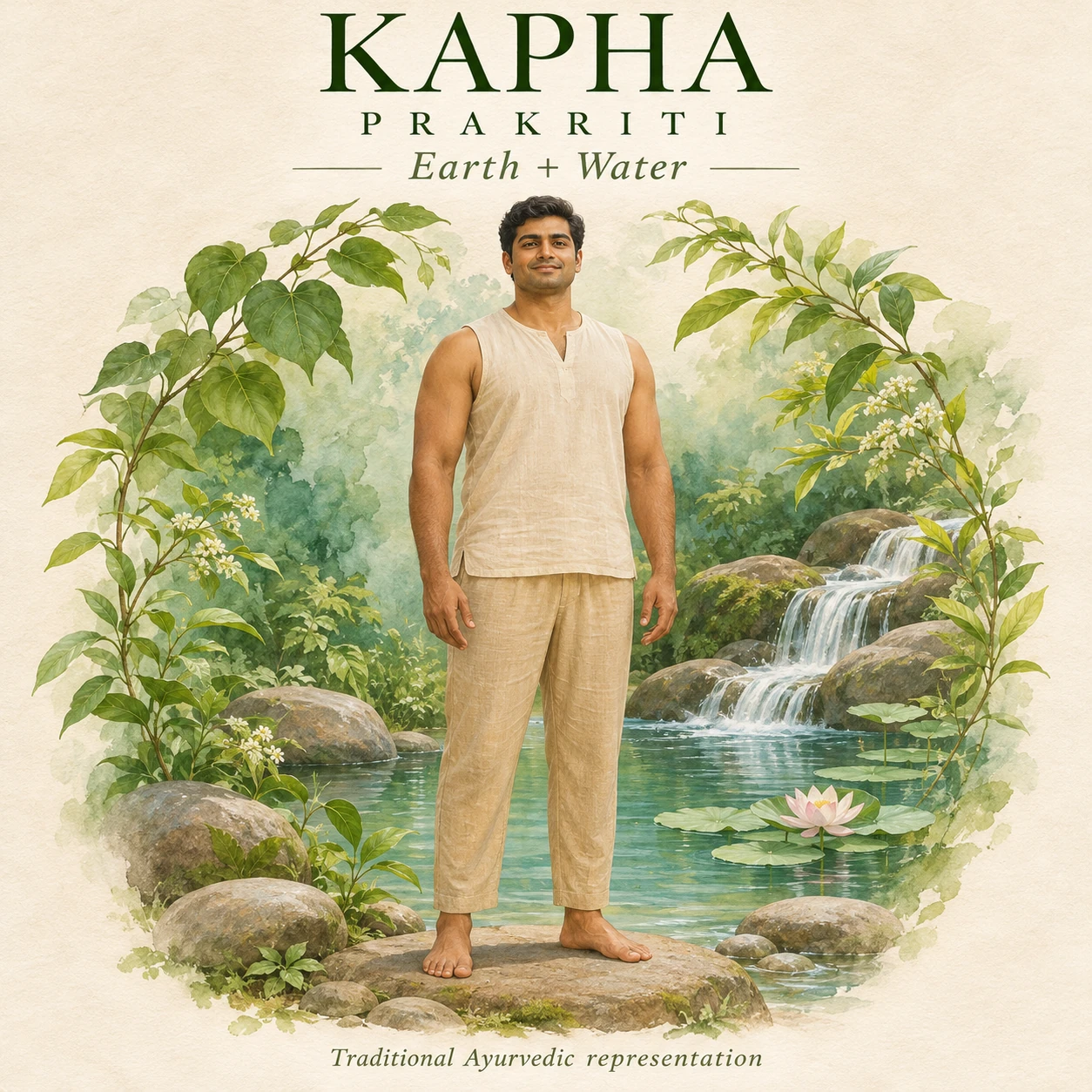
Vata, Pitta and Kapha: traditional Ayurvedic representations. Select an image to view it in full.
Why does a routine that feels comfortable for one person feel difficult for another? Why do we describe ourselves as naturally light sleepers, steady eaters, quick movers or people who feel the heat easily? These differences invite curiosity. Ayurveda explores long-standing individual tendencies through the concept of Prakriti.
Prakriti analysis is an Ayurvedic assessment of a person’s usual constitution. It considers patterns across physical characteristics, everyday functions and behaviour. Its value lies in asking thoughtful questions about the person behind the health concern. A label alone cannot explain everything about you.
This guide explains the traditional framework, what happens during an assessment and how to approach our free Prakriti self-assessment. It also explains where a questionnaire ends and a clinical consultation begins.
In this guide: What Prakriti means · Vata, Pitta and Kapha · Prakriti and Vikriti · A doctor’s assessment · Taking the questionnaire · Understanding your results · Common questions
What is Prakriti in Ayurveda?
The Sanskrit word Prakriti refers to nature or constitution. In classical Ayurvedic theory, a person’s constitution is established early in life and is relatively enduring. It is described through the predominance of three doshas: Vata, Pitta and Kapha. All three belong to the framework; a predominant dosha does not mean the others are absent.
Ayurveda considers constitution as one part of a wider assessment. The government’s C-DAC description of Prakriti assessment places it within the traditional tenfold examination, or Dashavidha Pariksha. A consultation therefore needs more than a dosha label.
Think of the result as a way to organise a conversation about your usual patterns. It should leave room for your history, circumstances and current concerns. It should not turn a complex person into a fixed personality category.
Vata, Pitta and Kapha: understanding the three doshas
Doshas are concepts within Ayurvedic theory. Their familiar associations with air, space, fire, water and earth express traditional qualities; they are not literal measurements of these elements inside your body.
Vata: movement and variability
Vata is traditionally associated with air and space, and with qualities such as lightness, dryness, coolness and movement. A Vata-oriented discussion may explore long-standing variability in appetite, lighter sleep, a lighter frame or a tendency to move quickly. Any single feature is insufficient to determine constitution.
Pitta: heat and transformation
Pitta is traditionally associated with fire and water, and with heat, sharpness and transformation. An assessment may explore a person’s usual appetite, tendency to feel warm, sweating and focused or intense working style. Being ambitious, having acidity or disliking hot weather does not establish a Pitta constitution.
Kapha: structure and steadiness
Kapha is traditionally associated with earth and water, and with stability, heaviness, coolness and smoothness. A discussion may consider a sturdier frame, steadier routines, deeper sleep or a measured pace. Body size alone does not determine Kapha, and these descriptions should never be used to judge someone’s character.
Can you have more than one predominant dosha?
Yes. The traditional classification includes seven broad patterns: Vata, Pitta, Kapha, Vata–Pitta, Vata–Kapha, Pitta–Kapha and a relatively balanced three-dosha pattern. Mixed patterns are recognised in Ayurveda; you do not need to force yourself into a single category. The Directorate of AYUSH, Delhi’s Prakriti overview describes this sevenfold classification.
A questionnaire score is not a competition. No type makes you a better person, and equal percentages do not automatically mean better health.
Prakriti and Vikriti: your usual pattern and your current state
Prakriti concerns your long-standing constitutional tendencies. Vikriti concerns the current pattern of disturbance or change assessed within Ayurveda. Keeping these ideas separate helps prevent a recent problem from being mistaken for a lifelong trait.
For example, imagine someone who usually sleeps soundly but has slept poorly for three weeks while caring for a relative. Answering every sleep question from those three weeks could distort their description of their usual pattern. Both facts matter: how they ordinarily sleep, and what has changed recently.
During an Ayurvedic consultation, the doctor can explore both timelines. A new symptom still deserves an appropriate assessment; calling it a dosha imbalance does not establish its medical cause.
How does a doctor assess Prakriti?
A careful assessment combines conversation with observation and, where relevant, examination or measurements. The CCRAS Prakriti assessment manual groups characteristics into physical, physiological, psychological and behavioural domains. It describes standardised methods for collecting information rather than relying on a single impression.
The conversation may explore your usual body frame, skin and hair characteristics, appetite, digestion, sleep, response to temperature, activity and habitual responses. Your doctor needs to know which features have been present for years and which appeared after an illness, treatment or change in circumstances.
The purpose of follow-up questions is clarity. “I sleep lightly” might mean that you have always woken easily, or that noise now interrupts your sleep. “I feel hot” might describe a familiar lifelong preference, or a recent change. These answers should not be interpreted in exactly the same way.
A clinician also considers the problem that brought you to the appointment, your medicines, medical history and relevant findings. Prakriti analysis does not replace medical reports, laboratory tests or imaging when those are needed.
Why does the assessment take time?
A considered assessment takes time because the doctor must clarify patterns, compare answers and understand context. The length varies with the person and the concern; there is no universal appointment duration. A longer discussion is useful when it improves understanding, not simply because it lasts longer.
You can make that conversation more useful by bringing examples: what your routine is usually like, when a change began and what you hope to understand. You do not need to arrive knowing your dosha.
How to take the Ayurveda Healing Tree self-assessment
Our Prakriti analysis questionnaire is an educational starting point for adults aged 18 and above completing it for themselves. It contains 24 questions and usually takes about 5–8 minutes.
- Start with your usual self. Think about long-standing patterns, particularly since early adulthood, rather than only how you feel today.
- Read the whole question. Notice whether it asks about your natural characteristics, typical habits or response in comparable conditions.
- Choose honestly. Select the answer that fits best. Where two descriptions fit equally, the questionnaire allows two choices. Use the uncertainty option when you cannot judge reliably.
- Keep recent changes in mind. Make a separate note of illness, medication, shift work or other circumstances that may be influencing an answer.
- Review without chasing a label. Correct genuine mistakes, but avoid repeating the questionnaire until it produces the type you prefer.
- Use the result to prepare questions. Bring your summary and any uncertain answers to a consultation if you want individual interpretation.
Weight and height are optional. If you enter both, the tool can include BMI; BMI does not determine your Prakriti. Contact details can be left blank for on-screen results only. Read the consent and information-use notice before continuing.
Our questionnaire is a preliminary educational tool. It is not the CCRAS Prakriti Assessment Scale and is not presented as a clinically validated diagnostic test.
How to understand your Prakriti results
Read the summary as a reflection of the answers you provided. If it shows percentages, these represent the questionnaire’s scoring pattern. They are not blood levels, measured quantities of dosha, percentages of health or probabilities of developing a disease.
If two scores are close, a small difference in an answer can change which one appears first. An uncertain or mixed result is an invitation to discuss the pattern, not a reason to worry or to change your answers until the chart looks more decisive.
A useful next step is to write down three things: which descriptions fit your usual experience, which do not, and which answers may reflect a recent change. That makes the report a practical conversation aid.
What does research tell us about Prakriti assessment?
Researchers are working to make assessment more consistent. CCRAS has developed a standardised assessment programme and an AYUR Prakriti Web Portal, with training for its users. The existence of a researched instrument does not mean every online quiz has the same evidence behind it.
An original study comparing Prakriti assessment tools found differences in agreement between methods, including weaker agreement involving a self-assessment tool. It illustrates why questionnaire results should be interpreted with attention to the method used and its limitations.
Research on classification, repeatability or biological associations is not automatically proof that a particular dosha-based diet or treatment improves health. That requires separate clinical evidence. Avoid promises that a quiz can reveal every disease risk, prescribe the ideal medicine or guarantee prevention.
What can you do with the information?
Use Prakriti analysis to begin a more specific conversation about daily life. Instead of asking only “What should a Pitta person eat?”, consider questions that describe your actual circumstances:
- Which of my reported traits appear long-standing, and which need a separate assessment?
- How do my work schedule, food preferences and existing health conditions affect the advice?
- What change would be realistic for me to try, and what outcome should we monitor?
- If a medicine is suggested, why is it appropriate for my current concern?
Advice about diet and daily routine should fit the individual. Avoid eliminating whole food groups, starting a restrictive “dosha diet” or choosing herbs solely from a questionnaire result.
If treatment is discussed, use our guide to questions to ask about Ayurvedic medicines. Tell your clinicians about medicines and supplements you already use. Do not stop prescribed treatment or postpone necessary care because of a Prakriti result. NCCIH’s overview of Ayurvedic medicine explains evidence limitations and relevant product-safety concerns.
Common questions about Prakriti analysis
Does my Prakriti change as I get older?
Ayurvedic theory treats the underlying constitution as relatively enduring. Your habits, circumstances, appearance and health can change, and your answers may change with them. A different quiz result by itself does not prove that your underlying constitution has changed.
Is an online Prakriti test accurate?
Accuracy depends on the tool, the questions, how answers are interpreted and what it has been validated to do. Our self-assessment offers a preliminary pattern for reflection. It cannot provide an examination or the contextual judgement of a clinician.
Is Prakriti the same as a medical diagnosis or a genetic test?
No. Prakriti is a traditional Ayurvedic constitutional concept. A questionnaire does not diagnose a disease, read your DNA or establish a specific medical risk. Research interest in possible biological associations should not be mistaken for a clinical genetic test.
Can children use this questionnaire?
This website’s questionnaire is for adults aged 18 and above. Please do not answer it on behalf of a child. A child’s concerns and development need an age-appropriate consultation.
Do I need medicines after taking the assessment?
A questionnaire result is not a reason to start medication. Whether treatment is needed depends on an individual clinical assessment, your concerns and the available evidence for the proposed treatment.
Explore your natural rhythm, then ask better questions
You do not need to fit every part of a description. The most useful outcome is a clearer account of your usual patterns and a better set of questions about your health.
Begin with the free Prakriti self-assessment. If you would like to discuss your result alongside a health concern, request an Ayurvedic consultation at Ayurveda Healing Tree in Panchkula or online. You can also read how to prepare for your appointment. Appointment requests require confirmation by the clinic.
This article provides general education about traditional Ayurvedic concepts. It does not diagnose a condition or prescribe individual treatment.
Sources and further reading
- C-DAC: AyurPrakritiWebAPI — traditional framework and assessment context.
- CCRAS: Manual of Standard Operative Procedures for Prakriti Assessment.
- Directorate of AYUSH, Delhi: Prakriti — traditional classification.
- Abhilash M and Sudhikumar K B. Development of a clinically useful tool for Prakriti assessment. International Journal of Ayurvedic Medicine. 2021;12(3):599–609.
- NCCIH: Ayurvedic Medicine — In Depth.