
Understanding Jatharagni and Ayurveda’s connection between digestive balance and everyday health.
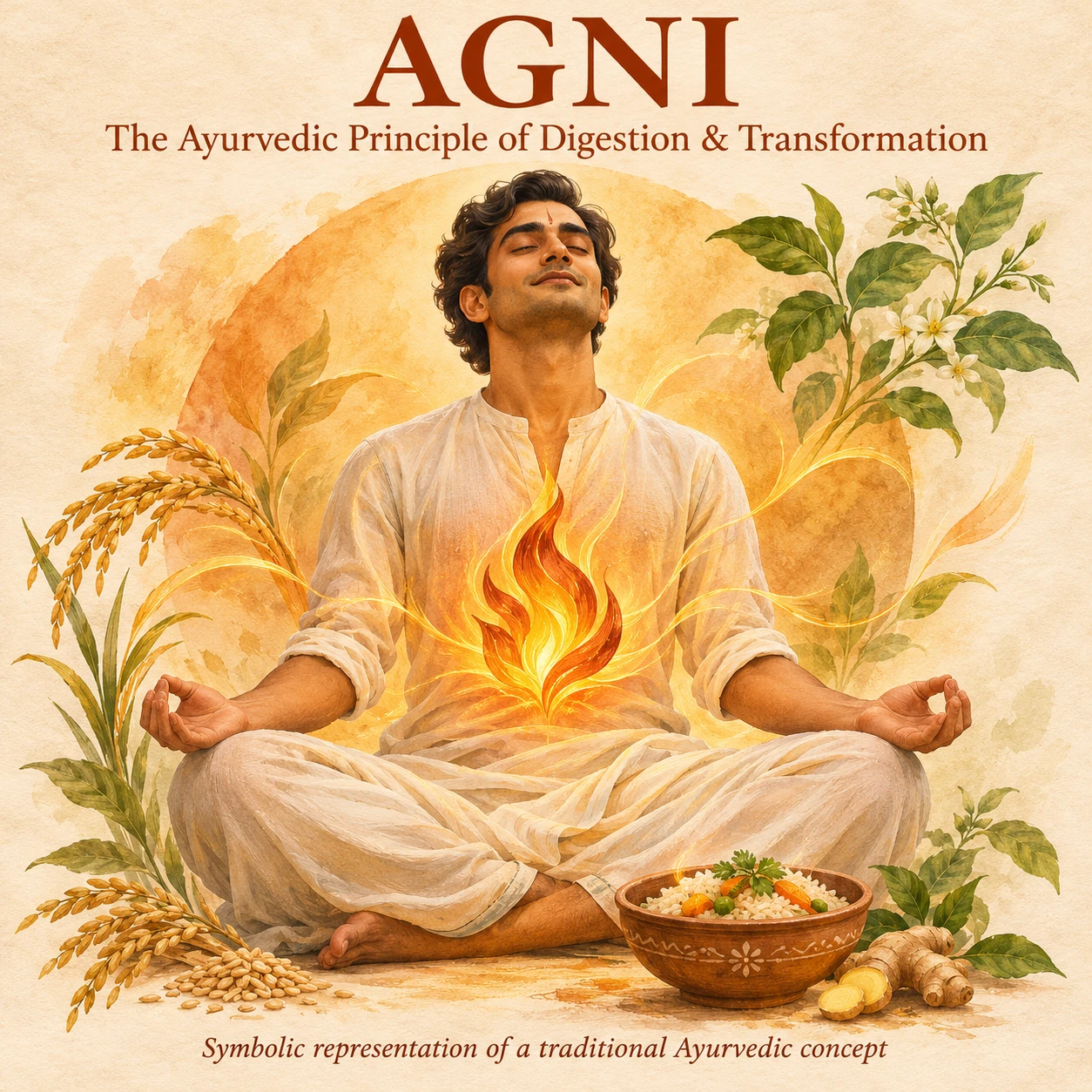
You can put thoughtful food on your plate and still find yourself asking: Why do I feel heavy after eating? Why does my appetite change so much? Why does the same meal feel comfortable one day and uncomfortable the next?
Ayurveda brings these questions into a discussion of Agni—the principle of digestion and transformation. Caring for Agni is a central theme in its approach to nourishment and health. The goal is balanced, appropriate function.
Meet Agni: The Ayurvedic Idea of Transformation
Agni literally means “fire.” In Ayurveda, it describes the processes through which food is digested and nourishment is transformed and used. It is a traditional explanatory framework, rather than a literal flame or a single laboratory measurement. It should not be equated directly with stomach acid, one digestive enzyme or the gut microbiome. [1]
The image of fire is useful because it invites us to consider both the food we provide and how we respond to it. A nourishing routine needs to suit the person living it.
Jatharagni: Where the Story of Nourishment Begins
Jatharagni, often called the digestive fire, refers to the principal Agni involved in digesting food in the gastrointestinal region. Classical Ayurveda gives it a leading role in supporting the further processes of tissue nourishment. [2]
Modern physiology explains digestion through coordinated organs, digestive juices, movement, nerves and hormones. Food is broken down into components that can be absorbed and used for energy, growth and repair. That makes digestive health important, although this modern account does not establish a one-to-one equivalence with Jatharagni. [3]
अग्नि और पोषण
यदन्नं देहधात्वोजोबलवर्णादिपोषकम्।
तत्राग्निर्हेतुराहारान्न ह्यपक्वाद्रसादयः॥
In this verse, food’s ability to nourish the tissues, Ojas, strength and complexion is attributed to the action of Agni; food that has not been properly transformed cannot provide that nourishment in the same way.
Charaka Samhita, Chikitsa Sthana 15/5. English meaning paraphrased from the classical teaching. [2]
The 13 Forms of Agni: From Digestion to Tissue Nourishment
A common classical framework describes 13 forms of Agni: one Jatharagni, five Bhutagni and seven Dhatvagni. This groups Agni by its role in digestion and transformation. The four states discussed below describe how digestive activity functions; they are a separate classification. [9]
Jatharagni — the principal digestive Agni
Jatharagni acts on ingested food and supports the subsequent processes of nourishment in Ayurvedic theory.
जठराग्नि का महत्व
अन्नस्य पक्ता सर्वेषां पक्तॄणामधिपो मतः।
तन्मूलास्ते हि तद्वृद्धिक्षयवृद्धिक्षयात्मकाः॥
The Agni that digests food is regarded as the chief among the transforming fires. The other forms of Agni depend on it and are described as increasing or diminishing with it.
Charaka Samhita, Chikitsa Sthana 15/39. [2]
The five Bhutagni — elemental transformation
Bhutagni describe transformation in relation to the five Mahabhuta, the traditional elemental categories. They are conceptual classifications, not five separately identified modern digestive enzymes. [10]
| Bhutagni | Associated element |
|---|---|
| Parthivagni / Bhaumagni | Prithvi — earth |
| Apyagni | Ap / Jala — water |
| Taijasagni / Agneyagni | Tejas / Agni — fire |
| Vayavyagni | Vayu — air |
| Nabhasagni / Akashagni | Akasha — space |
The seven Dhatvagni — transformation within the Dhatus
Each of the seven Dhatus has its corresponding Dhatvagni, associated with its nourishment and transformation. The English descriptions below are approximate aids to understanding Ayurvedic categories, not exact anatomical equivalents. [9]
| Dhatvagni | Associated Dhatu |
|---|---|
| Rasa Dhatvagni | Rasa — nourishing fluid |
| Rakta Dhatvagni | Rakta — blood |
| Mamsa Dhatvagni | Mamsa — muscle / flesh |
| Meda Dhatvagni | Meda — fat / adipose tissue |
| Asthi Dhatvagni | Asthi — bone |
| Majja Dhatvagni | Majja — marrow |
| Shukra Dhatvagni | Shukra — reproductive tissue / reproductive essence |
Four States of Agni: Balanced, Sluggish, Variable or Excessively Sharp
Calling Agni “strong” can be misleading if it suggests that more heat or a bigger appetite is always desirable. Ayurveda describes four functional states: [4]
| State | Traditional pattern | What may be discussed in a consultation |
|---|---|---|
| Samagni — समाग्नि | Balanced, regular digestive activity. | Digestion suited to the quantity of food, without recurring digestive discomfort. |
| Mandagni — मन्दाग्नि | Sluggish or diminished activity, associated with Kapha disturbance. | Reduced appetite, prolonged fullness, heaviness or nausea after eating. |
| Vishamagni — विषमाग्नि | Variable or irregular activity, associated with Vata disturbance. | Fluctuating appetite, inconsistent tolerance of meals, bloating or variable bowel habits. |
| Tikshnagni — तीक्ष्णाग्नि | Excessively sharp activity, associated with Pitta disturbance. | Intense or frequent hunger, burning, thirst or heat-related discomfort. |
These are traditional patterns for clinical interpretation, not a self-diagnosis checklist. Similar symptoms can have different medical causes. [4]
Atyagni — when the fire becomes excessive
Atyagni (अत्यग्नि) describes an abnormally intensified state with voracious appetite and associated disturbance. It is discussed as an extreme pathological state, rather than an extra item in the 13-form classification or a desirable sign of health. [4]
Samagni is the aim. Intense hunger, burning or discomfort should not be celebrated as proof of excellent digestion. These descriptions also cannot diagnose the cause of a symptom.
मन्दाग्नि और रोग
रोगाः सर्वेऽपि मन्देऽग्नौ सुतरामुदराणि तु।
अजीर्णान्मलिनैश्चान्नैर्जायन्ते मलसञ्चयात्॥
The verse attributes disease, particularly the classical group of abdominal disorders called Udara Roga, to weakened Agni, indigestion, unsuitable or impure food, and accumulation of waste.
Ashtanga Hridaya, Nidana Sthana 12/1. [11]
This expresses a classical Ayurvedic explanation of disease. It should not be presented as modern proof that every disease begins in the stomach or that improving Agni guarantees prevention.
Good Agni, Good Immunity: Understanding the Connection
Within Ayurvedic theory, appropriate digestion supports nourishment, strength and Ojas, a concept associated with vitality. This helps explain why Ayurveda connects digestive care with resilience. Ojas should not be presented as another name for antibodies or a measurable immune-system score. [2]
Modern evidence supports the importance of adequate nutrition for normal immune function. Deficiencies in several vitamins and minerals can impair immune responses. Immunity is complex, however, and cannot be judged simply from appetite, bowel habits or a feeling of lightness after food. [5]
A balanced digestive routine supports nourishment; adequate nourishment helps support normal immune function.
This is a sounder health message than promising that “good Agni prevents disease.” Agni-focused care has not been established as a guarantee against infections, diabetes, cancer or other illnesses. Ayurvedic concepts can guide an individual consultation, but they do not replace vaccination, appropriate investigations or necessary treatment. [5] [6]
Ama: A Traditional Concept That Needs Careful Interpretation
Ayurveda uses Ama in its discussion of incomplete digestion and transformation. It is often loosely translated as “toxins,” but this does not identify a specific substance that a blood test will measure. Feeling tired or bloated does not prove that toxins have accumulated or that a cleanse is needed. [1]
Care for Your Digestion Through Everyday Habits
अग्नि की रक्षा
तस्मात्तं विधिवद्युक्तैरन्नपानेन्धनैर्हितैः।
पालयेत् प्रयतस्तस्य स्थितौ ह्यायुर्बलस्थितिः॥
One should carefully protect Agni with suitable, wholesome food and drink taken appropriately, because the maintenance of life and strength is described as depending on its stability.
Charaka Samhita, Chikitsa Sthana 15/40. [2]
Start with a routine that you can describe and maintain. These steps support a useful conversation with your clinician:
- Notice meal timing and portion size. Aim for a reasonably consistent routine and comfortable portions. Classical dietary guidance emphasises timing, suitability and quantity. Avoid turning this into rigid fasting rules. [2]
- Make room for food variety. Include suitable sources of protein, vegetables, fruit, whole grains and healthy fats. Repeatedly restricting foods can make adequate nutrition harder to achieve. [7]
- Track patterns before making sweeping changes. For a few days, note meals, symptoms and medicines. Bring recurring patterns to a consultation; a diary helps describe a problem but does not prove its cause.
- Give sleep and movement a place in the plan. Regular physical activity and sufficient sleep support general and immune health. Avoid smoking and excessive alcohol. [7]
- Choose individual advice over a universal “Agni booster.” A recommendation should account for your symptoms, health conditions and medicines. Do not start concentrated herbal products or stop prescribed treatment simply because a product promises stronger digestion. [6]
If you have diabetes, are pregnant, are underweight or have a history of disordered eating, discuss substantial dietary changes or fasting with your healthcare professional first.
Your Prakriti and Your Present Digestion Tell Different Stories
Our Prakriti analysis guide explores long-standing constitutional tendencies. A current digestive problem deserves its own history: when it started, how it behaves and what has changed.
A constitution label alone cannot explain persistent burning, a new loss of appetite or unexplained weight loss. During an Ayurvedic consultation, bring your symptoms, medicines and relevant reports into the discussion alongside your usual patterns.
When Your Digestion Needs Medical Attention
Seek medical assessment for persistent or worsening digestive symptoms. Severe or constant abdominal pain, vomiting blood, black tarry stools, chest pain, trouble swallowing or unexplained weight loss need prompt attention. Do not delay care by assuming these symptoms are simply an Agni imbalance. [8]
Make Digestive Care Personal
For your next consultation, write down three things: your main digestive concern, when it began and what you have already tried. This gives your doctor a clearer starting point than a self-assigned Agni label.
At Ayurveda Healing Tree, you can request an in-clinic or online consultation to discuss your concerns and an appropriate individual plan.
Care for your digestion. Nourish your body. Build a routine that supports your health.
Educational information about a traditional Ayurvedic framework; not a diagnosis or an individual treatment plan.
References and Further Reading
1. Charak Samhita New Edition: Agni.
2. Charaka Samhita, Chikitsa Sthana 15, especially verses 3–5 and 38–40. Classical concepts and Sanskrit verse; English meaning paraphrased.
3. NIDDK: Your Digestive System & How It Works.
4. Sushruta Samhita, Sutra Sthana 35: Examination of the Patient.
5. NIH Office of Dietary Supplements: Immune Function and Infectious Diseases.
6. NCCIH: Ayurvedic Medicine—In Depth.
7. CDC: Healthy Habits—Enhancing Immunity.
8. NIDDK: Symptoms & Causes of Indigestion.
9. Charak Samhita New Edition: Dhatvagni.
10. Charak Samhita New Edition: Bhutagni.
11. Ashtanga Hridaya, Nidana Sthana 12/1, Sanskrit source.